English typing lessons
The fastest way to learn to type is not to attack the whole keyboard at once — it is to learn it in small, ordered groups, starting from the home row. These free English typing lessons do exactly that, one finger-group at a time, so you build correct habits from the very first key.
Structured English typing lessons are the backbone of learning to touch type. Instead of memorising a picture of the keyboard, you learn each key as a movement your fingers own — starting from a fixed anchor and extending outward in a deliberate order. This guide explains how the lessons are sequenced, why that order works, and how to get the most from each session. When you are ready, start free on the English typing lessons page.
Why lessons beat “just typing”
Anyone can open a document and peck out words, but that only reinforces a two-finger habit with a low ceiling. Lessons work because they isolate a few keys at a time and repeat them until the movement becomes automatic — the same way you learned to play scales before songs. Each new lesson adds only what your fingers are ready for, so you are always slightly challenged but never overwhelmed.
How the lessons are ordered
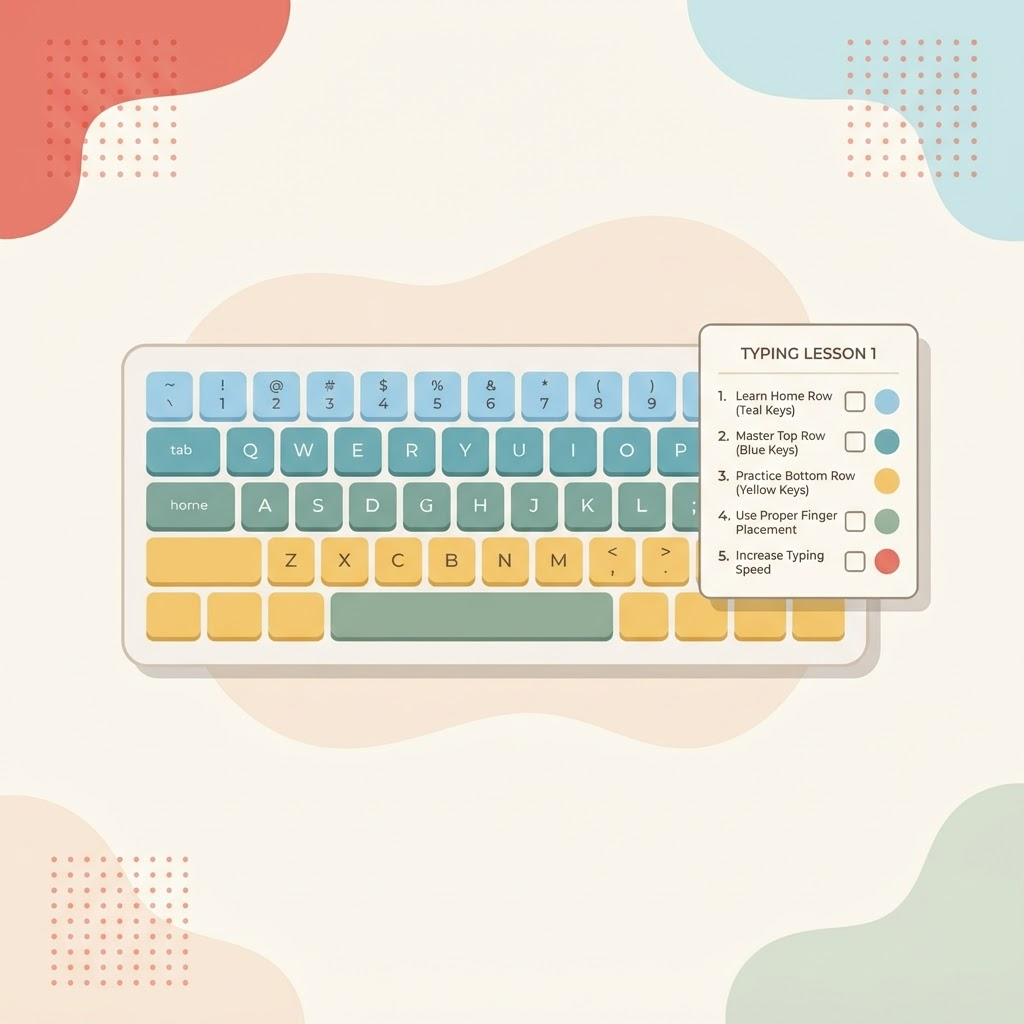
- Home row (A S D F — J K L ;). Your anchor. You learn to place all eight fingers by feel, using the small bumps on the F and J keys to return without looking.
- Top row (Q–P). Each finger reaches up from its home key and comes straight back. This teaches “reach and return”, the core movement of touch typing.
- Bottom row (Z–M). The same movement downward. The bottom row is the least used, so it comes last of the letter rows.
- Capitals and punctuation. Using the opposite hand's Shift key, plus the common punctuation you need for real sentences.
- Numbers and symbols. The number row and symbols, added once letters are automatic.
What the guided keyboard shows you
Each lesson runs with an on-screen keyboard that highlights the next key to press and colours it by which finger should do the work. Follow the colours rather than your instinct — they are what rewire your fingers to share the load correctly instead of overusing your index fingers. Keep your eyes on the screen and let the highlight, not your hands, tell you where to go.
How to practise a lesson well
- Slow down for accuracy. Speed is a by-product of clean repetition. If you are making mistakes, you are going too fast.
- Return home after every key. Fingers should always come back to A S D F and J K L ; so they never lose their place.
- Repeat, don't rush ahead. Redo a lesson until it feels comfortable before unlocking the next group.
- Keep sessions short and daily. Fifteen focused minutes a day builds muscle memory faster than an occasional long grind.
What comes after the lessons
Once the lessons feel automatic, move from isolated keys to real text with English typing practice, then measure your progress with a quick typing speed test. When a drill starts to feel repetitive, switch to typing games to keep the habit enjoyable. The full roadmap — posture, home row, lessons, practice, tests and games in order — is laid out in our complete guide to English typing practice.
Frequently asked questions
How long should each lesson take?
A single lesson is only a few minutes, but the goal is repetition, not completion. Redo each one until you can type it without looking, even if that takes several passes over a few days.
Should I finish all lessons before practising real text?
No. Once the home row and a couple of other rows feel automatic, start mixing in practice with real words. Lessons and practice work best side by side.
I already type with two fingers — do I still need lessons?
Yes, and they help most here. Two-finger typing plateaus early; the lessons retrain your hands to use all ten fingers. Expect to feel slower for a week or two before you pull ahead for good. Our beginner's guide covers how to make that switch.
Do I have to look at the keyboard?
Try not to. The on-screen highlight replaces the need to look down, and every glance you avoid strengthens the muscle memory you are building.
Start your first lesson
The best time to start is now, on the home row. Open the English typing lessons, put your fingers on A S D F and J K L ;, and take the first group slowly. Fifteen minutes a day for a few weeks is genuinely all it takes to type without looking.